

Dancing With the First Light
Issue #21 -- The Glimpse begins where the gift stops being only personal and starts becoming a responsibility.

🔥 Intro Letter to the Soul Riders
Soul Rider,
I have been quiet lately… just quiet.
I choose not to obscure this space with excessive explanations. Certain seasons demand stillness rather than public confession, and some valleys are meant to be crossed without a dramatic soundtrack. True resilience isn’t found in relentless external force; it emerges when we face the essential work of calming the storm inside our own chests.
So I return the only way I promised myself I would: taking one small, definitive step. We move forward one page at a time, allowing presence to speak directly through this journal.
Perhaps this is the defining realization of Stage 6: The Glimpse. Emerging from the depths, emergence isn’t always marked by a loud declaration. Often, it is marked by a steady breath. We return more deliberate, more grounded, focused less on transient happiness and deeply committed to the discipline of internal peace. Authentic peace requires confronting reality, because it is impossible to look at the world today and pretend everything remains unshakeable… Oil prices fluctuate on financial screens, but the real impact settles heavily in everyday kitchens. Every shifting metric carries a human cost; a distant conflict materializes locally as a higher utility bill, a blocked transit route translates directly to more expensive meals, and global instability ultimately strains a parent calculating expenses down the supermarket aisle.
This is the stark reality of modern global crises: structural distance offers no protection to the vulnerable. Our world is profoundly interconnected, yet connectivity without conscious empathy creates a system that pressures the fragile first. Still, we are required to step forward. We do so not out of apathy or blind surrender, but because a true purpose remains constant regardless of our immediate emotional state.
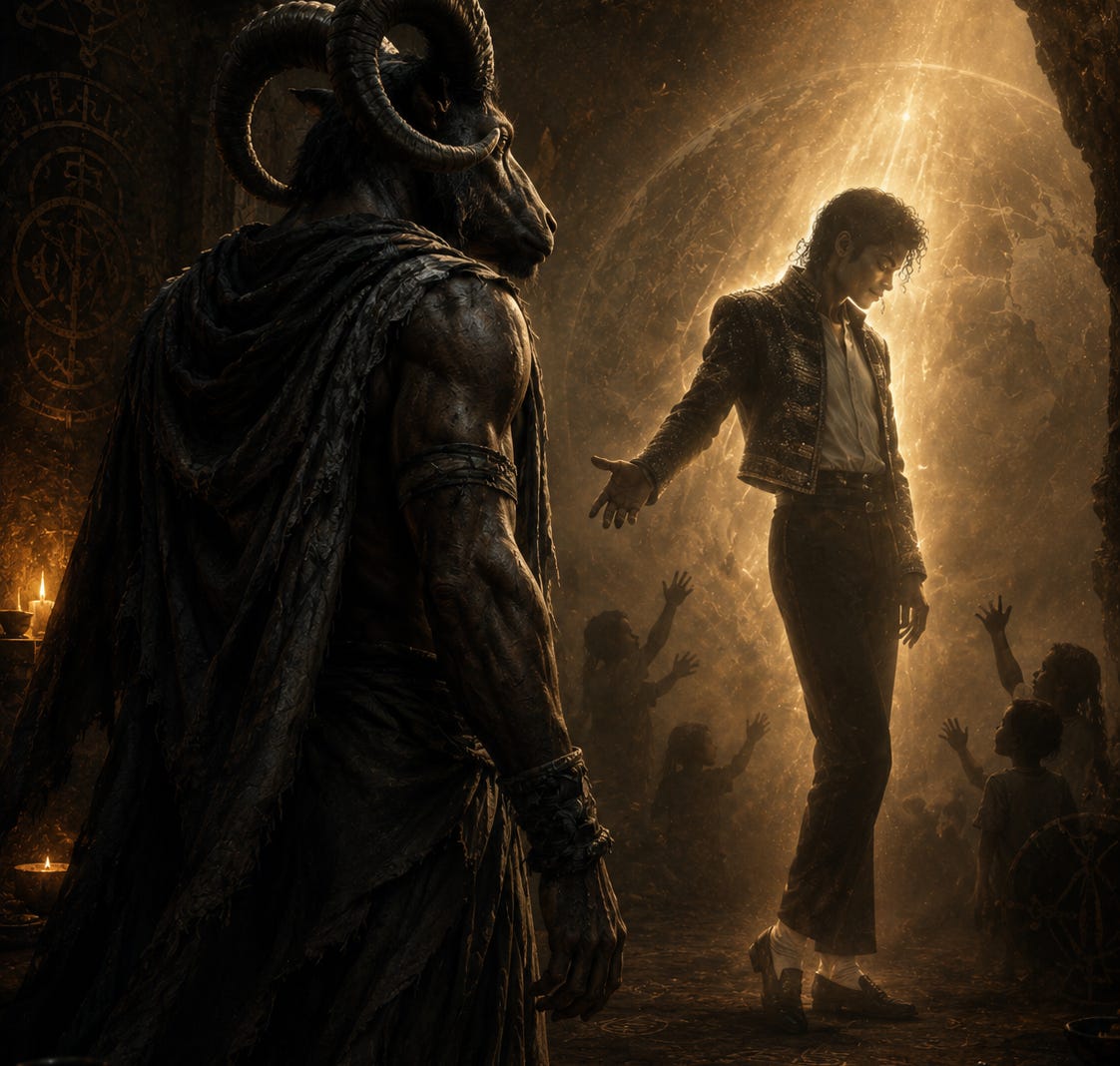
That clarity is exactly why this stage opens with a reflection on Michael Jackson. I didn’t initially intend to introduce his legacy here, but a specific realization remained with me after revisiting his work. His 1993 Super Bowl performance stood as a profound demonstration of presence. At that time, I was still a kid myself, probably more interested in playing soccer - real football😊 - in the streets of Pétion-Ville than sitting still in front of a television. The world could be making history on a screen, and we would still be chasing a ball between dust, concrete, laughter, and someone’s mother calling from a balcony.
But that is not the point.
The point is that when I look back at Michael Jackson’s 1993 Super Bowl performance now, I see something I could not have fully understood then.
The crowd waited as he stood completely motionless, holding absolute focus while the entire stadium erupted around him. Before a single word, before a single step, he showed the first lesson of power: presence. He opened with Jam, moved through the electricity of Billie Jean, and brought the question of race, identity, and human unity into the stadium with Black or White.
But the performance did not end as spectacle. It widened into conscience.
A children’s choir carried We Are the World, and then came Heal the World, turning the field into something larger than entertainment. For a moment, the Super Bowl was no longer only a game, a brand, or a national ritual. It became a public mirror.
What about the children?
What about the forgotten?
What about the people paying for conflicts they never chose?
What about the mothers doing math in supermarket aisles because decisions made far away have entered their kitchens?
And even though Man in the Mirror was not part of that performance, its spirit was standing there like an invisible spine. The message was the same: change cannot remain an opinion. Responsibility cannot remain a song. The mission must become larger than our comfort, larger than our grievances, and stronger than the temptation to withdraw from the world.
We are left with an inescapable question:
Do we always control when a vital responsibility calls on us?
Perhaps our choice resides entirely in the initial commitment and the daily decision to show up. We retain control over whether our individual talents serve as a genuine contribution or mere ego, a healing medicine or a performance, a shelter for others or empty noise. Yet, profound callings rarely wait for an invitation before they begin to demand our focus. They frequently arrive long before we feel fully prepared, and our gifts transition into responsibilities the exact moment they begin to impact the lives of others.
This is where the transition truly takes shape. It does not wait for flawless conditions, easy circumstances, or the illusion that every old wound has vanished. Instead, it begins with the first precise realization after surviving the dark: the understanding that past adversity does not define the entire narrative, that temporary silence was never a permanent end, and that our capabilities are meant to be shared. True capability, when detached from accountability, inevitably degrades into a subtle form of harm.
The challenges of the world have not softened, and the daily news has not grown gentler. However, the internal vision has restored its focus. This time, Soul Rider, we are not seeking convenience. We are asking a far more elevated question: What will our unique contribution heal?
With fire and grace,
Terod
🪞 Poetic Piece
Could We Heal the World?
Could we heal the world from the man in the glass,
Before we ask the future to bury our past?
Could we clean our hearts before raising our hands,
And teach the young power without making demands?
Could we guard them from fire, yet teach them the flame,
So they rise with a spine and remember their name?
Could we give them more than shelter and bread,
But courage, clear vision, and truth in the head?
Could we stop chasing comfort disguised as peace,
And break the old chains before pain gets released?
Could we hear the ancestors drum through the night,
Saying, “Child, be the medicine, carry the light”?
Could we turn every wound into wisdom that serves,
And give the next generation the future it deserves?
Could we stand at the mirror with nothing to prove,
And let responsibility teach power how to move?
Could we ask, when the loud world starts to swirl:
What did my gift heal today in this world?
🏛️ Michael Jackson and the Responsibility of Greatness
The first light after the cave does not arrive to comfort the ego; it arrives to sober the spirit. That is the demanding mercy of Stage 6: The Glimpse. When you emerge from the absolute stillness of the descent, you do not return with answers for the world. You return with a question for yourself. The darkness has done its work, stripping away the illusion that survival was the final destination. Now, in the quiet clarity of the dawn, the soul is forced to look at its own contents and ask: What is my gift for?
To answer that, we must look into a mirror large enough to reflect both the heights of human capability and the terrifying depth of its weight. Michael Jackson remains that mirror. His life was not merely a trajectory of celebrity; it was an archetypal study in the physics of greatness. He represents the precise, agonizing friction that occurs when a personal gift expands into global visibility, and that visibility hardens into an unyielding burden of responsibility.
We live in a world that voraciously consumes the gifted. It mythologizes them, uses them, and projects its own private, chaotic storms onto them until the human being disappears beneath the weight of the symbol. The danger for any Soul Rider - whether your stage is a stadium or a kitchen table - is allowing that external attention to define your internal worth. When the world’s applause or its judgment becomes your primary language, you lose the sovereignty of your soul. Jackson’s life is a masterclass in the cost of being seen, a reminder that the brighter the outside lights, the deeper the discipline required to protect the flame within.
Michael Jackson was recognized by Guinness World Records for supporting 39 charities, including organizations connected to AIDS, cancer, children, education, sickle cell research, YMCA programs, and the United Negro College Fund. That alone puts him in the upper tier of celebrity humanitarian giving.
He also built humanitarian work into the actual mythology of his art. His impact was not only financial. He made charity, hunger, racism, children’s suffering, war, and environmental destruction part of global pop consciousness. That is a rare kind of impact: the stadium became a pulpit, the music video became a mirror.
His art endured because he understood that entertainment, at its apex, must bend toward conscience. The takeaway from his iconic 1993 Super Bowl performance was not the dance steps, but the absolute command of presence and discipline used to turn a massive spectacle into a public moral inquiry. Through works like Man in the Mirror, Heal the World, Earth Song, and We Are the World, he converted pop culture into a serious, universal moral language. He forced a sleeping world to look past its private fences and confront its own systemic failures. He proved that greatness is not defined by how many people move to your rhythm, but by how responsibly you direct their focus once you have their attention.
This is where the lesson becomes intensely personal for us. Your gift does not need to be a global voice to carry a global consequence. Your gift may be your writing, your parenting, your martial arts discipline, your leadership, your silence, or simply the hard-won wisdom of your survival.
But the law of the forge remains absolute: the moment your capability touches another human being, it is no longer exclusively yours. It becomes an environment they must live in.
If power is not consciously trained by responsibility, it inevitably degrades into an elegant form of internal or external harm. Talent without operational discipline quickly scatters into empty noise. Pain left unrefined by service becomes a private prison, and influence executed without deep compassion becomes a weapon that wounds the fragile first.
To step into the clarity of Stage 6, we must routinely stand before the mirror and ask the heavy questions of the text:
What has my gift touched?
Who is affected by the way I use my voice?
Where has my talent become larger than my discipline?
What part of my pain is asking to become service?
What will my power heal?
MJ’s life does not answer those questions neatly. That is exactly why it is useful. He is not a clean symbol. Clean symbols are often too easy. They let us admire without changing. But complex mirrors force us into maturity. They remind us that the gifted can be loved and consumed, celebrated and judged, lifted and isolated, mythologized until the human almost disappears.
And that too is a lesson.
Do not let the world consume the part of you that was meant to serve. Do not let applause become your compass.
Do not let criticism become your cage.
Do not confuse visibility with worth.
Do not confuse being needed with being whole.
The Soul Rider’s best self is not built by becoming untouchable. It is built by becoming responsible. Strong enough to carry light without turning it into ego. Soft enough to stay human without collapsing under pressure. Wise enough to know that a gift is not a crown. It is a tool. A seed. A blade. A drum. A torch… and what do we do with a torch?
We do not wave it only so people can admire the flame; we use it to help the next generation See… That may be the most important part.
Our ultimate responsibility is always to those who are watching us climb. We cannot claim to be healing our world if we are failing to build structures that protect and empower the younger generation. Shielding them from the immediate cruelties and exploitative machinery of modern life is a vital baseline, but protection alone is a passive strategy. We must actively prepare them to stand. We must provide them with unshakeable roots, severe discipline, and examples of power that refuse to humiliate or break when conditions grow dark. We must teach them that true healing is not a soft sentiment; it is spiritual logistics, a rigorous strategy, and the exact architecture required to make love sustainable.
No one carries the road alone. But as you step forward into the light, remember that the dawn is more than a reward for surviving the cave… it is a summons.
The Glimpse begins where the gift stops being only personal and starts becoming a responsibility.
🎧 Listen While You Reflect
1. Michael Jackson — “Man in the Mirror”
The moral spine of the issue. The mirror becomes a discipline: before we demand a better world, we must confront the version of ourselves contributing to the one we already have.
2. Beyoncé — “I Was Here”
A reflection on legacy. Not fame for fame’s sake, but the desire to leave proof that our life touched someone, lifted something, healed something.
3. John Lennon — “Imagine”
A fragile but necessary dream. It asks us to picture a world beyond division, not as naïve escape, but as a first act of moral imagination.
4. Tupac — “Changes”
The street testimony of a wounded world. Tupac turns pain into diagnosis, exposing how poverty, fear, racism, and broken systems keep repeating themselves until someone interrupts the cycle.
5. Bob Marley & The Wailers — “Redemption Song”
A song of inner freedom and ancestral memory. It reminds the Soul Rider that responsibility begins when we stop waiting for permission to become free.
6. Youssou N’Dour feat. Neneh Cherry — “7 Seconds”
A global prayer about innocence, race, misunderstanding, and the hope that humanity can still meet before hatred teaches us its language.
7. Mikaben — “Tout lwanj se pou ou”
This is the humility anchor. A reminder that power is not ownership. The gift passes through us, but its deepest source is higher than us. For the Soul Rider, this song brings the knees back to the ground before the hands reach for the crown.
Reflection Note:
Listen slowly, Soul Rider…
Listen for the question underneath the melody:
If the power comes from higher than me, what am I doing with it while it passes through my hands?
🧠 Brain & Soul
Power, Responsibility, and the Dance of Integrated Knowledge
Power is never biologically or spiritually neutral. The moment your influence expands, it rewires the pathways of both the mind and the soul. Modern science reveals that when we feel seen, praised, or obeyed, the human nervous system instantly fires up. Confidence expands, dopamine rises, and the body physically stands taller inside its own skin. This is fundamental biology. The brain is evolutionary wired to notice status, recognition, and control. But biology without internal wisdom becomes a dangerous trap, a golden prison wearing expensive perfume. Influence is far too volatile to be left unanchored in the wild. This exact intersection is where neuroscience and ancient traditions meet on a single, unyielding truth: power must be subjected to structural discipline.
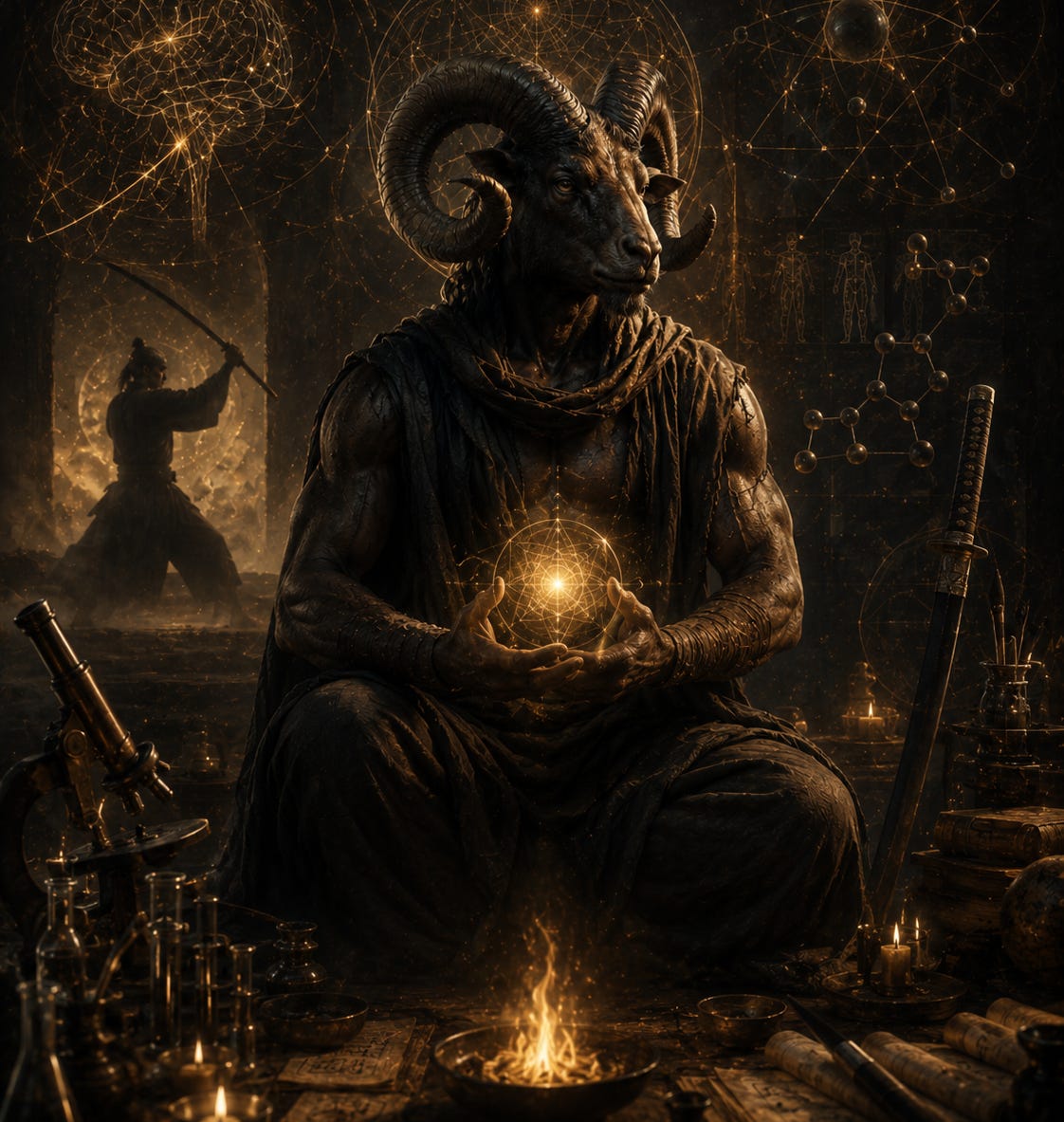
Every ancient civilization worth listening to, recognized that raw impact could destroy a community if left untethered. Traditional cultures placed power under a strict code. The warrior had an unyielding standard, the elder carried communal accountability, and the healer practiced absolute energetic restraint. Master teachers, senseis, and storytellers understood that human impact was a sacred deposit, never a personal toy to play with. Consider Miyamoto Musashi, the legendary samurai and master strategist. His timeless text, The Book of Five Rings, was never just about winning physical sword fights. It was a demonstration of extreme physical and cognitive control under intense pressure. Every flawless strike appeared effortless only because it was backed by exhausting repetition and absolute physical discipline. Musashi taught that you must control your own center completely before you ever extend your force outward. For the Soul Rider, this exposes the ultimate danger of raw talent: expression without operational discipline degenerates into empty noise, and influence without active compassion harms the vulnerable first. Freedom without preparation is not liberation; it is chaos.
This realization defines the operational parameters of Stage 6: The Glimpse. Vision beyond a passive aesthetic experience becomes an immediate summons to systemic accountability. Once you see the underlying patterns of your life, you lose the right to claim they are accidental. Once you decode the anatomy of your own suffering, you can no longer responsibly use it as a weapon to damage the people around you. Power does not alter who you are; it ruthlessly exposes what is already contained within the quiet spaces of your character. It acts as an energetic accelerant. If your foundation houses fear, power manifests as rigid control. If your foundation retains hidden shame, power manifests as hyper-performative vanity. If your foundation suffers from emptiness, power becomes an insatiable hunger for validation. Conversely, a foundation governed by strict discipline instantly matures into precise service. And if your foundation is anchored in authentic love, power transitions into an unshakeable structure of shelter for the fragile.
Because power behaves as a mirror, our primary responsibility is to provide the younger generation with an impeccable blueprint of execution. Shielding the young from the predatory mechanisms of a consumerist world is a necessary baseline, but passive protection is entirely insufficient to ensure survival. We must explicitly engineer their capacity to stand independently. This requires passing down precise psychological language, severe operational discipline, deep cultural roots, and unshakeable moral courage. We fail them if we merely preach strength while demonstrating behavior that humiliates others, just as we fail them if we demand global transformation without proving we can master our own impulses when no one is watching.
Michael Jackson’s art gives us a modern image of that lesson. His movement looked free, but behind the freedom was discipline. Behind the grace was repetition. Behind the spectacle was pressure. And at his best, he used entertainment as a doorway into conscience. Musashi’s strategic resolve is a rigorous spiritual logistics system. It commands us to cease holding external systems entirely responsible for the foundational internal labor we refuse to begin. It does not minimize external injustice, nor does it ignore broken social architecture; instead, it serves as a permanent reminder to every Soul Rider that we must never allow our past wounds to dictate the style of our leadership. We execute our power precisely where our personal agency resides: in the deliberate management of our tone, our micro-habits, our financial allocation, our targeted focus, and our next responsible step.
While science provides the objective metrics to analyze our behavioral execution, ancient wisdom preserves the timeless symbols to guide our ultimate direction. Art generates the profound emotional resonance required to sustain our memory, and the body serves as the physical dojo where these principles are structurally embodied. True mastery exists exclusively in the seamless dance between these domains of knowledge. We do not weaponize power against responsibility; we train power through the exact mechanisms of responsibility. We do not separate science from spirit; we allow science to be sharpened and humanized by the spirit. Ancient wisdom does not stand in opposition to modern life; it walks directly through contemporary fire with new shoes and old, unblinking eyes.
Before you close your journals tonight, stand before your own mirror and run the mandatory metrics of Stage 6. Ask what your current achievement is teaching the people who are watching you climb. Ask what your talent is actively doing to the true baseline of your character. Ask how your immediate influence is shifting the energetic alignment of the room you just entered. Ask what specific component of your pain you are preparing to convert into structural service. Bypass the easy summaries. Face your execution with absolute alignment, and answer the only question that matters to the lineage: What did my power heal today?
📜 Quote of the Week
“For unto whomsoever much is given, of him shall be much required.”
Luke 12:48, KJV
Takeaway
This is the entire soul of Issue #21; Power Is a Trust, Not a Trophy
The gift is not only a blessing.
It is a responsibility.
The voice, the talent, the platform, the strength, the intelligence, the influence, the survival story, the pain that made you wiser, all of it comes with a question attached:
What will you do with what passed through your hands?
If I was given strength, who did it shelter?
If I was given a voice, who did it lift?
If I was given pain, what wisdom did it become?
If I was given light, what darkness did it help someone cross?
The measure of power is not how much attention it receives.
The measure of power is how much life it helps restore.
🕯️ Closing Words
What Will the Gift Become?
Soul Rider,
As we close this issue, I carry a special thought for my former schoolmate and friend Michael Benjamin, Mikaben.
Another artist gone too soon.
Another voice that left the stage before the heart was ready.
Another reminder that life does not always ask for our permission before it changes the music.
I think of Michael Jackson too.
Different worlds. Different stages. Different storms.
But both remind us of the same unbearable truth:
A gift is beautiful.
A gift is powerful.
A gift can touch nations.
But a gift does not make us immortal.
So why are we given life?
Why are we given talent, voice, movement, wisdom, love, children, pain, memory, rhythm, discipline, breath?
Maybe not to own them.
Maybe not to worship them.
Maybe not… to use them as proof that we are special.
Maybe we are given gifts so they can pass through us and become shelter for someone else.
I think about this every day as a father.
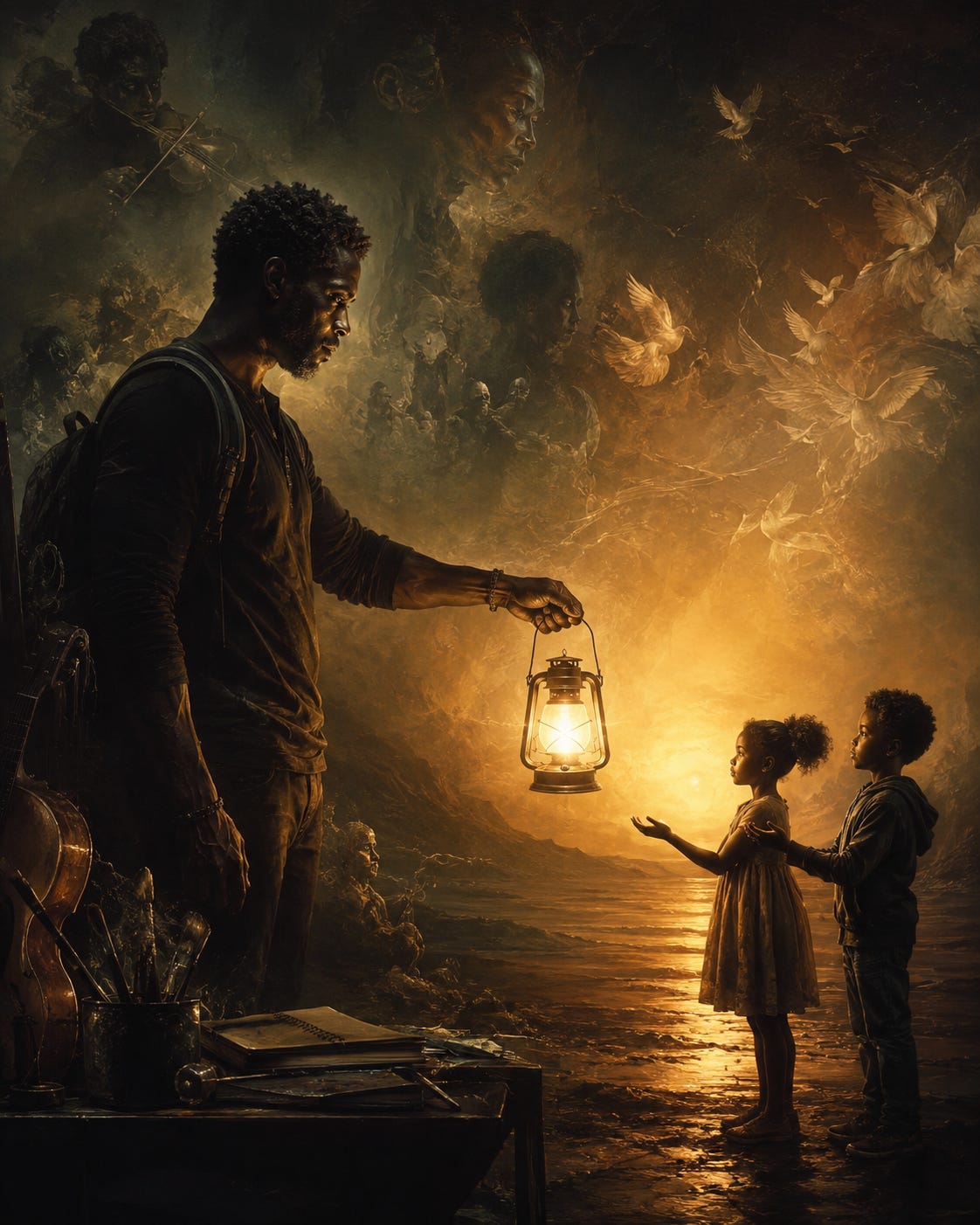
My daughter’s name means “Talent”… and I miss her. Deeply. In ways words can only approach, never fully carry. I miss her, and I think about her brother too. Strangely he reminds me of Mikaben… spoiler alert. I think about what I am passing down to them, not only as money, advice, or protection, but as insight. As example. As a way of standing in the world.
What do I want them to know when life places a gift in their hands?
I want them to know that talent is not just something you have.
It is something you must learn how to carry.
I want them to know that power without humility becomes dangerous.
That beauty without discipline can be wasted.
That pain without wisdom can become a weapon.
That love without courage can become silence.
And I want them to know that no gift from God, the universe, the ancestors, or life itself should end in ego alone.
It must become service.
That mission is complicated right now. Heavily complicated. There are distances, papers, borders, responsibilities, and storms that make the heart feel like it is doing push-ups under water. But no mission is more important to me.
Not fame.
Not applause.
Not being understood by everyone.
Not winning every argument.
Not even the comfort I sometimes wish I could disappear into.
The mission is to become the kind of man whose children can inherit more than survival.
A clearer mirror.
A steadier flame.
A deeper root.
A stronger language for their own light.
Because the younger generation does not only need protection. They need preparation. They need to know how to carry their gifts without being consumed by them. They need to know how to enter a loud world without losing their inner music.
So maybe this is where Issue #21 leaves us:
Beyond certainty.
Beyond peace.
Beyond enough wound healed…
With a question worthy of the light:
What will my gift become in the hands of those who come after me?
If Stage 5 was the cave, Stage 6 is the first light touching the wall.
And that light does not say, “You are finished.”
It says:
Begin again.
Carry better.
Heal something.
Pass the flame.
With fire and grace, always,
Terod Naej
So beautiful
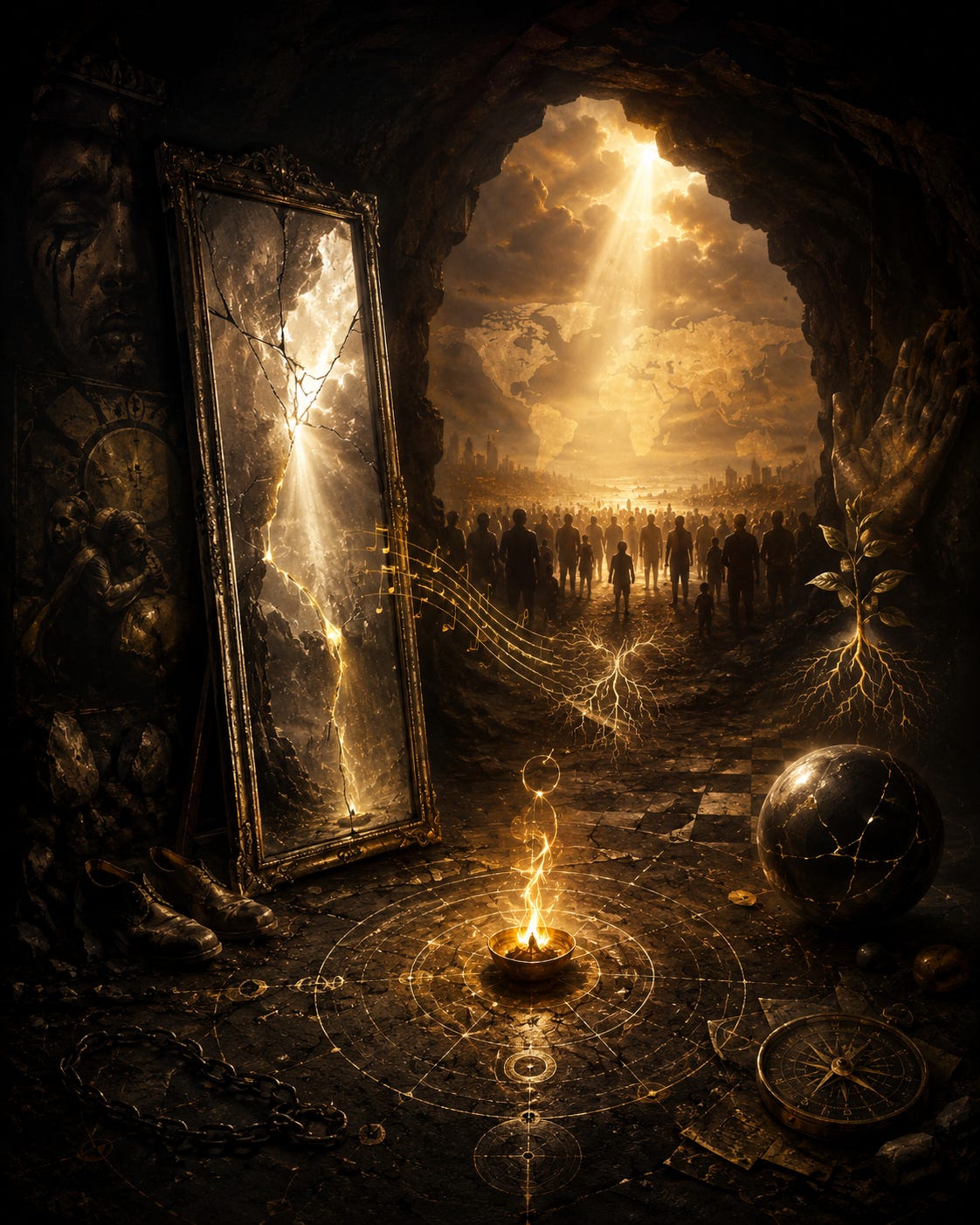
The hands carrying the gift..? Hands can hold ego, love, paperwork, distance, all the annoying human stuff... and still be asked to become shelter.